

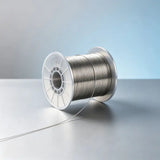


Description
xTitanium Alloy Wire: A Strong, Lightweight Wire for Demanding Work
Titanium alloy wire is a thin, continuous metal wire drawn from a high-strength, heat-treatable titanium alloy rather than from soft, unalloyed (commercially pure) titanium. It combines the natural corrosion resistance and light weight of titanium with noticeably higher tensile strength, spring behavior, and fatigue life, which is why it is widely specified for welded fabrications, medical and dental components, eyewear frames, jewelry, woven mesh, fasteners, springs, aerospace parts, and marine equipment. Supplied as coiled wire, spooled wire, or straight cut lengths, titanium wire can be drawn down to fine and ultra-fine diameters for delicate weaving, coiling, and precision forming work.
Because the same base material is described online as titanium wire, titanium alloy wire, high-strength titanium wire, or titanium filler wire, this page explains the material, the available forms and tempers, the production route, real-world applications, and how to select the right condition for a project — so engineers, buyers, and fabricators can specify titanium alloy wire with confidence.
Titanium Alloy Wire vs. Commercially Pure (CP) Titanium Wire
The two are often listed side by side, and the choice depends on how much forming, strength, and corrosion service the part needs:
| Comparison point | Titanium alloy wire | Commercially pure (CP) titanium wire |
|---|---|---|
| Structure | Strengthened alpha-beta microstructure from controlled alloying additions | Essentially unalloyed single-phase titanium |
| Strength | High tensile and fatigue strength; holds spring loads well | Lower strength, softer and very ductile |
| Formability | Formable, with more springback; benefits from correct temper | Extremely easy to bend, weave, and cold form |
| Typical work | Springs, fasteners, aerospace and structural parts, high-load welds, eyewear | Woven mesh, chemical anodes, deep-drawn parts, general welding filler |
| Corrosion resistance | Excellent for most industrial and marine environments | Slightly higher in the most aggressive chemical media |
In short, choose titanium alloy wire when strength, fatigue resistance, and elastic return matter most; choose CP titanium wire when maximum softness, deep forming, or the highest chemical compatibility is the priority.
Why It Is a Practical Engineering Choice
- High strength at low weight — roughly 56–60% the density of steel, while delivering strength levels associated with much heavier metals.
- Genuine corrosion endurance — a stable passive oxide film handles salt water, chlorides, acids, and alkaline service far better than ordinary steel wire.
- Non-magnetic and biocompatible — suitable for instruments, wearables, and body-contact products without magnetic interference.
- Versatile delivery — coiled, spooled, or straight wire; bright, pickled, or polished surface; annealed or cold-drawn temper; fine to heavy cross-sections.
- Fabrication-friendly — bends, coils, winds, weaves, cold-heads, and welds cleanly with standard titanium shop practice.
Properties & Performance
The figures below describe typical behavior for a strengthened alpha-beta titanium alloy wire in general industrial service. Exact values move with diameter, temper, heat treatment, and testing direction, so they should be treated as a selection guide rather than a fixed guarantee.
Mechanical Properties
Strength-to-Weight Advantage
Titanium alloy wire reaches annealed tensile strength on the order of 850–950 MPa, and cold-worked conditions can run higher still — at a density of only about 4.4–4.5 g/cm³. The practical result is wire that supports meaningful static and dynamic loads while keeping finished assemblies light, a combination valued in aerospace, motorsport, portable equipment, and high-end eyewear where every gram counts.
Fatigue Resistance and Spring Behavior
The alloy tolerates repeated bending, flexing, and cyclic loading better than soft titanium, and it returns to shape after deflection when correctly tempered. This elastic memory is what makes it suitable for spring wire, clips, clasps, retainers, and components that flex thousands of times.
Why This Matters for Repeated-Load Parts
A wire that relaxes or permanently bends after a few cycles causes a part to fail even if its static strength is adequate. The combination of fatigue endurance and controlled springback helps titanium alloy wire keep clamping force, seal pressure, and shape over a long service life — important in fasteners, fishing tackle, orthodontic components, and mechanical retainers.
Corrosion and Chemical Resistance
The Self-Repairing Oxide Layer
Titanium instantly forms a tight, adherent oxide film when exposed to oxygen. If the surface is scratched, the film re-forms on its own in the presence of air or moisture, which gives the wire its characteristic stability in seawater, brine, chloride solutions, nitric and chromic acids, bleaches, and many alkaline environments. This is why titanium wire replaces stainless or carbon steel in marine, desalination, chemical processing, and electroplating work where rust or pitting would otherwise shorten component life.
Thermal and Physical Properties
| Property | Typical range / behavior | What it means in use |
|---|---|---|
| Density | Approx. 4.4–4.5 g/cm³ | Light finished parts; lower handling and structural weight |
| Melting range | Approx. 1,600–1,660 °C | Suited to elevated-temperature engineering environments |
| Elastic modulus | Approx. 110–115 GPa | Noticeable, controllable flexibility versus steel |
| Thermal conductivity | Approx. 6.6–7.2 W/m·K | Relatively low heat transfer, useful in fixtures and tooling |
| Thermal expansion | Approx. 8.6–9.0 ×10⁻⁶ /K | Predictable dimensional behavior on heating and cooling |
| Magnetic response | Effectively non-magnetic | Safe near sensors, instruments, and imaging equipment |
| Continuous service | Up to roughly 400 °C (oxidation-limited) | Retains useful strength in hot working environments |
Non-Magnetic and Biocompatible Character
Titanium is naturally non-magnetic and tolerates prolonged contact with skin and tissue, which supports its use in surgical instruments, dental and orthodontic work, hypoallergenic jewelry, eyeglass frames, and wearable devices. For regulated medical work, material test reports and mill documentation can be supplied to order so the wire can be matched to the buyer's qualification process.
Forms, Tempers and Surface Finishes
How the wire is delivered has a direct effect on how it runs on production equipment. Titanium alloy wire is offered in several supply forms, mechanical conditions, and surface finishes, and these can be combined to match a specific forming, weaving, welding, or coiling process.
Supply Forms
Coiled wire
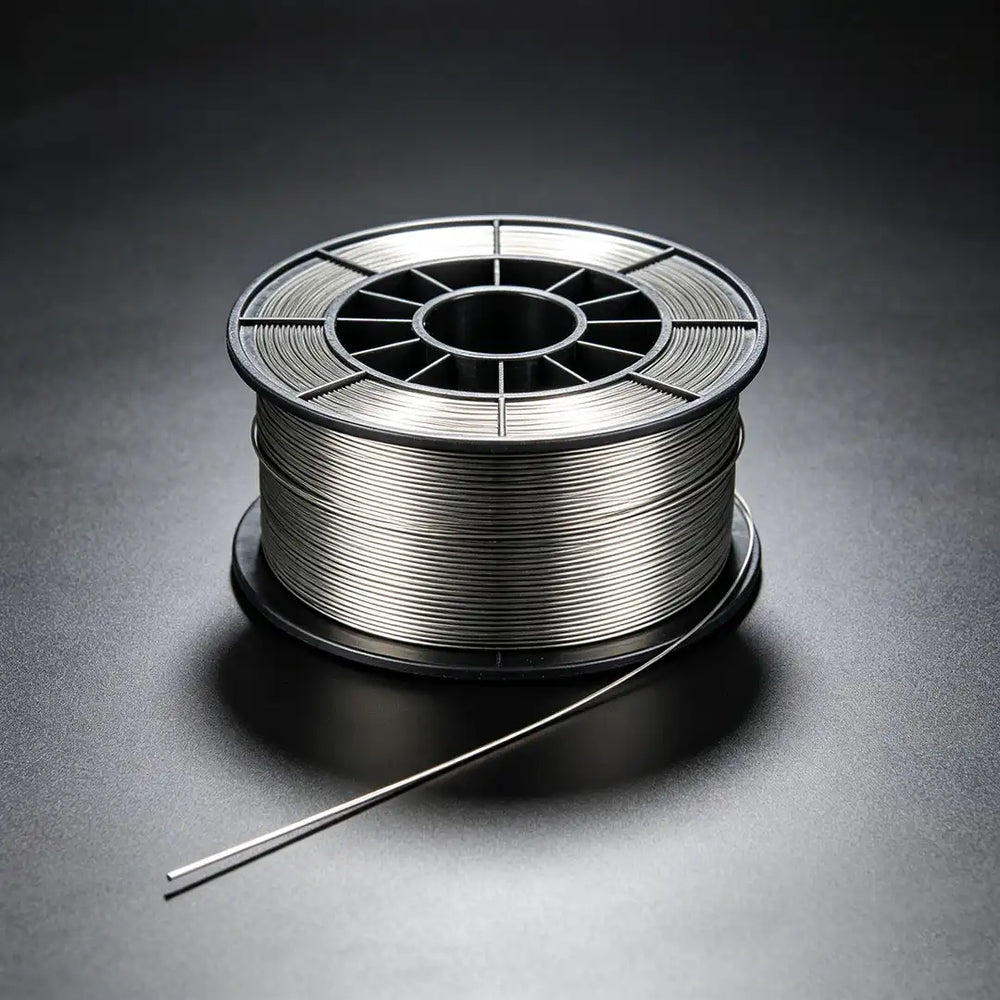
Titanium coil wire is wound into compact coils for general fabrication, straightening, cutting, and batch processing. Coils suit workshops that re-process the wire in-house and applications that do not need a mounted spool.
Spooled wire
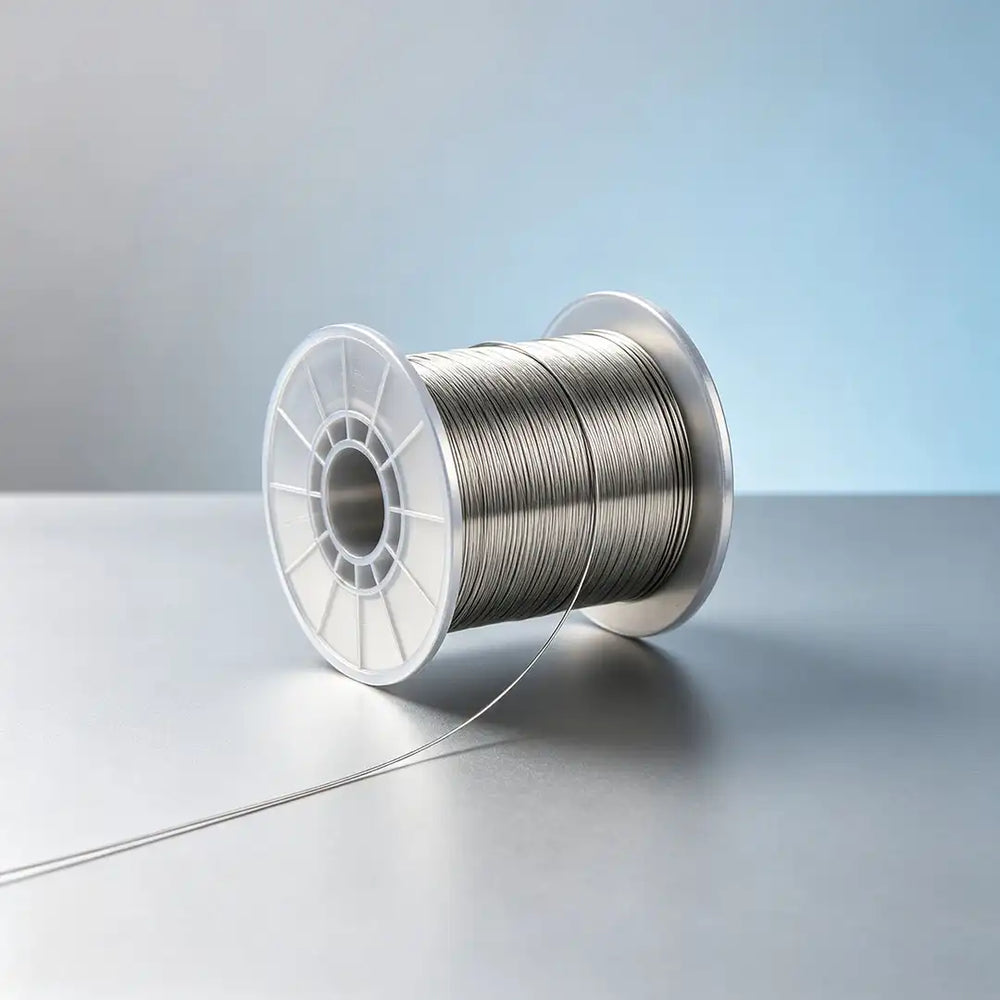
Spool wire (wire on a spool) feeds smoothly and continuously from automated payoff, making it the natural choice for CNC coiling, robotic TIG welding, braiding, knitting, weaving lines, and high-volume automatic assembly where tangle-free payout matters.
Straight cut wire
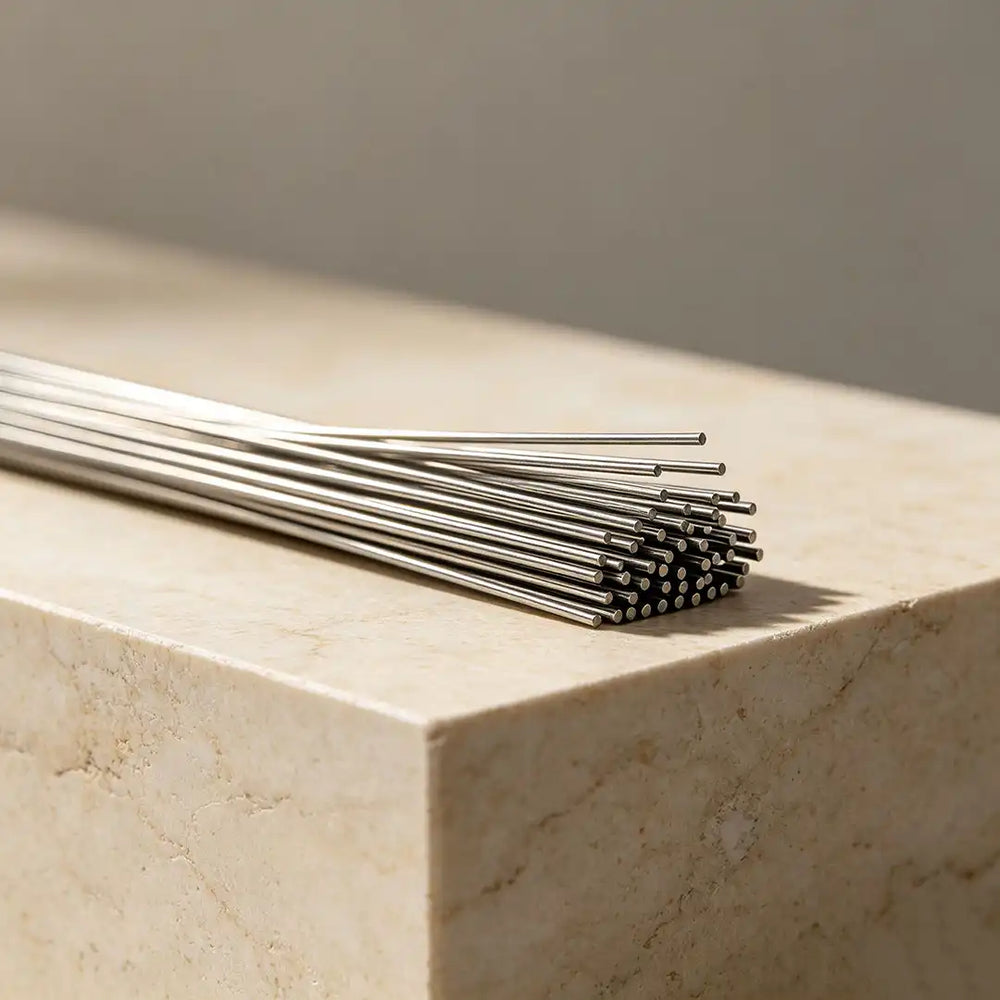
Straight (straightened and cut) titanium wire is supplied in fixed lengths for pins, spokes, rods, frame components, jewelry findings, and any part that must arrive flat and ready to use without further straightening.
Tempers (Mechanical Condition)
Annealed (Soft) Condition
Annealed titanium alloy wire — commonly vacuum- or atmosphere-annealed — is the most ductile and forgiving condition. It is the default for tight bending, deep forming, weaving, cold heading, and parts that are heat-treated after shaping. Annealed wire shows the least risk of cracking during aggressive deformation.
Cold-Drawn Conditions
Cold-drawn (work-hardened) wire trades some ductility for higher strength, a stiffer feel, and stronger springback. It is selected for springs, retaining clips, straight push-pull elements, and components that must hold position without heat treatment after forming.
Matching Temper to Spring and Forming Work
As a rule of thumb, the more severe the deformation in one operation, the softer the incoming wire should be; the more the finished part relies on elastic return and stiffness, the more a cold-drawn condition helps. Specifying the temper up front avoids cracked bends on one hand and lazy, relaxed springs on the other.
Surface Finishes
Bright
Bright and bright-annealed wire has a smooth, clean, silvery surface with minimal scale — preferred for visible consumer products, jewelry, eyewear, and clean forming.Pickled
Pickled (descaled) wire has the oxide layer removed chemically for a uniform matte-silver industrial surface ready for welding, forming, or further finishing.Polished
Polished wire offers the smoothest finish for cosmetic parts, medical and dental components, and surfaces that must be easy to clean and sterilize.As-drawn / dark
An as-drawn or residual-oxide surface is an economical option for hidden structural work, anode frames, and industrial fabrications that are cleaned or finished later.Diameter Range and Packaging
Titanium alloy wire is drawn across a wide cross-section range. Fine and ultra-fine wire begins at roughly 0.05–0.10 mm for micro-weaving, braiding, and delicate medical work; general-purpose wire commonly runs from about 0.10 mm to 6.0 mm for forming, welding, springs, and fasteners; heavier wire and wire rod above this range can be arranged to order. Coils, spools of various weights, and fixed straight lengths are all available, with packaging designed to protect the clean surface during transit and storage.
Note: diameter is a selection range rather than a fixed catalog value — describe the cross-section, form, temper, and finish your process needs, and the wire can be drawn and packaged to match.
How Titanium Alloy Wire Is Produced
Understanding the production route helps buyers appreciate why clean surfaces, controlled tempers, and verified chemistry matter in finished titanium wire.
From Ingot to Wire Rod
Production begins with a melted and consolidated titanium ingot produced under controlled atmosphere to keep interstitial elements low. The ingot is forged and hot-rolled into a bar, then reduced into wire rod — the intermediate, heavier feedstock that will eventually be drawn down to the finished diameter.
Multi-Pass Cold Drawing
Die Reduction and Intermediate Annealing
Wire rod is pulled, pass by pass, through precision drawing dies that shrink the cross-section and lengthen the wire. Because titanium work-hardens as it deforms, the line alternates drawing with intermediate annealing to restore ductility, allowing the wire to reach fine diameters without internal cracking. Each pass improves surface uniformity and the consistency of the final cross-section.
Surface Conditioning Between Passes
Between reductions, the wire is cleaned and conditioned to remove drawing lubricant, minor oxide, and surface marks. This repeated cleaning is what separates a smooth, weld-ready bright wire from a wire that carries contamination into a final bend, braid, or weld pool.
Heat Treatment and Final Surface Work
The wire is then brought to its specified temper — annealed for maximum formability or left in a cold-drawn condition for strength and spring response. Final surface work (pickling, bright annealing, polishing) sets the cosmetic and cleanliness level, after which the wire is wound into coils, spooled, or straightened and cut to length.
Quality Verification
- Chemistry verification against the ordered material specification, confirming the intended alloy composition.
- Mechanical testing, including tensile and bend checks, to confirm strength and ductility for the chosen temper.
- Surface inspection for cracks, laps, scale, and contamination that could affect forming or welding.
- Non-destructive checks where required, such as ultrasonic or eddy-current inspection for critical applications.
- Mill documentation — material test reports (MTRs) and certificates traceable to the production heat for aerospace, medical, and regulated buyers.
Common titanium and titanium alloy wire is produced and tested against widely recognized wire specifications such as ASTM B863, giving buyers a clear, internationally understood reference for chemistry, condition, and testing.
Applications Across Industries
The same drawn material serves very different end markets depending on form, temper, finish, and diameter. Below is how titanium alloy wire is actually used.
Welding and Fabrication
A large share of titanium wire is consumed as titanium welding wire and titanium filler wire, most often for TIG welding of titanium vessels, pipework, tanks, exhaust systems, and repair work on aerospace and motorsport components. Clean, oxide-free spooled filler wire feeds steadily and produces sound, ductile weld metal when paired with proper inert-gas shielding. Straight filler rods are used for manual TIG work, while spooled wire suits continuous and automated setups.
Medical, Dental and Surgical
Titanium's non-magnetic, body-compatible character makes the wire a staple in surgical instruments, endoscopic and guide components, fixation and closure wire, and implantable-device manufacturing, where clean polished surfaces and full material traceability are essential.
Orthodontic and Dental Uses
In dentistry, titanium wire is formed into orthodontic archwires, clasps, and retainer components that flex repeatedly in the mouth while remaining corrosion-resistant and hypoallergenic — a direct benefit of the alloy's fatigue life and passive surface.
Aerospace, Defense and Automotive
High strength-to-weight and elevated-temperature stability put titanium alloy wire into aircraft and engine hardware, control and locking wire, safety and tie wire, defense equipment, motorsport valvetrain and exhaust components, and lightweight fastener stock. Reducing mass in these sectors directly improves payload, fuel efficiency, and performance.
Marine, Chemical and Electroplating
Saltwater and aggressive chemical service exploit the alloy's corrosion endurance: marine rigging and fittings, desalination components, chemical-process hangers, anode lead wire, and electroplating racks all use titanium wire where stainless alternatives pit, stain, or corrode. Non-magnetic behavior is also useful in sensor-adjacent and submerged equipment.
Eyewear, Jewelry and Consumer Goods
Titanium wire is a premium material for lightweight, flexible eyeglass frames, temple arms, nose bridges, and hinges, where springback and low weight define wearing comfort.
Jewelry, Craft and Wearable Uses
For jewelry making, craft wire, rings, bangles, ear wires, findings, and wearables, titanium offers a hypoallergenic, tarnish-resistant alternative to nickel-containing alloys, with bright or polished finishes that need no plating to stay attractive.
Mesh, Filtration and Woven Products
Fine titanium wire is woven, knitted, or welded into wire mesh, filter screens, woven cloth, demister pads, electrode meshes, and strainers for chemical, food, pharmaceutical, and high-temperature filtration. The material's corrosion resistance keeps mesh openings stable and clean in aggressive fluids where ordinary steel mesh would degrade.
Fasteners, Springs and Cold-Headed Components
Cold-heading-quality wire is formed into titanium screws, bolts, rivets, and pins, while spring-temper wire is coiled into compression, extension, and torsion springs, clips, and retainers. The combination of light weight, fatigue strength, and corrosion resistance makes these small components disproportionately valuable in aerospace, marine, and high-end consumer products.
Fishing and Outdoor Tackle
Titanium fishing leader wire and bite leaders resist kinking and corrosion, carry high breaking strength for their diameter, and survive repeated flex and saltwater exposure — the same spring and fatigue properties that serve industrial springs. Outdoor gear such as tent and pole components likewise benefits from the light, springy wire.
How to Choose the Right Titanium Alloy Wire
Specifying titanium alloy wire is straightforward once four decisions are made in order.
Step 1 — Match the Form to the Process
Automated, continuous lines (welding, coiling, braiding, weaving) run best on spooled wire with controlled payout; in-house straightening and batch shops tend to prefer coils; parts that must arrive ready to assemble should be ordered as straight cut wire.
Step 2 — Match Temper and Finish
Choose annealed wire for severe bending, cold heading, and weaving; choose cold-drawn wire for stiffness, springs, and push-pull elements. Match the surface to visibility and cleanliness: bright or polished for cosmetic and medical parts, pickled for general industrial welding and forming, as-drawn for hidden structural work.
Step 3 — Match Diameter to the Job
Balance strength, flexibility, and the equipment that will handle the wire. Finer cross-sections bend and weave more easily and suit mesh, braid, and micro-components; heavier cross-sections carry structural and fastening loads.
Fine and Ultra-Fine Wire Considerations
At very small diameters, surface cleanliness and tangle-free spooling become critical because any nick or snag is large relative to the wire itself. Specify smooth bright or polished fine wire on well-wound spools for micro-weaving, medical braid, and precision coil work.
Step 4 — Match Documentation to the End Market
General industrial work typically needs only a mill certificate, while aerospace, medical, and defense customers often require full material test reports, heat traceability, and non-destructive inspection. Stating the documentation requirement at the inquiry stage prevents delays later.
Fabrication and Secondary Processing
Titanium alloy wire is built to be converted into finished parts. The notes below summarize the main secondary operations and how the incoming wire condition affects them.
Straightening, Cutting and Bending
Coiled wire can be straightened and cut in-house with roller straighteners; pre-straightened cut wire skips this step. Bending should account for the alloy's elastic springback — over-bend slightly, fixture the part, or use annealed wire for tight radii to avoid cracking.
Welding and Joining Notes
When the wire itself is used as filler, keep it clean and shield the weld zone, trailing bead, and underside with inert gas until the metal cools, since hot titanium absorbs oxygen, nitrogen, and hydrogen and becomes embrittled. Clean, oxide-free titanium filler wire and dedicated titanium tools prevent iron contamination and discoloration.
Weaving, Coiling and Cold Heading
Fine annealed wire weaves and braids smoothly on mesh looms; spring-temper wire coils into consistent springs on CNC coilers; soft, sound wire with a clean surface cold-heads into fastener heads without splitting. Matching temper to the operation is the single biggest factor in stable, repeatable production.
Cleaning, Handling and Storage
- Store wire in dry conditions and keep spools and coils covered to preserve the bright surface.
- Handle with clean gloves and avoid steel tool contamination that can cause surface discoloration.
- Degrease before welding or heat treatment; use stainless-steel-safe or titanium-dedicated cleaning baths.
- Avoid dragging the wire across sharp edges, which can nick fine diameters and initiate fatigue cracks.
Frequently Asked Questions
Is titanium alloy wire stronger than pure (CP) titanium wire?
Yes. The alloyed, alpha-beta wire is substantially stronger and stiffer with better fatigue and spring performance, while CP titanium wire is softer and more ductile for deep forming and weaving. Choose the alloy for load-bearing and spring parts and CP wire for maximum formability and the most aggressive chemical compatibility.
What is titanium alloy wire used for?
It is used for welding filler wire, medical and dental components, eyeglass frames and jewelry, woven mesh and filters, fasteners and springs, aerospace and marine hardware, electroplating racks, and fishing leaders — anywhere light weight, corrosion resistance, and reliable strength are needed together.
Can titanium alloy wire be used as welding wire?
Yes. Clean, oxide-free titanium wire is widely used as TIG filler wire and in continuous spool-fed welding, provided the hot weld zone is fully protected with inert shielding gas. Both straight filler rods and spooled wire are available depending on whether welding is manual or automated.
Is it suitable for skin-contact or medical products?
Titanium is non-magnetic, corrosion-resistant, and well tolerated by the body, which makes the wire suitable for jewelry, wearables, eyeglass frames, dental and surgical components. For regulated medical use, specify the required polished finish and mill documentation or material test reports up front.
Coil, spool, or straight wire — which is needed?
Choose spooled wire for automated, continuous payout such as welding, coiling, and weaving; coiled wire for batch fabrication and in-house straightening; and straight cut wire for fixed-length pins, frame parts, and ready-to-assemble components.
Does titanium alloy wire rust or corrode?
It does not rust like steel. Its self-healing passive oxide film provides strong resistance to seawater, chlorides, and many acids and alkalis, which is why it replaces stainless wire in marine, chemical, and electroplating environments.
Can it be supplied as fine or ultra-fine wire?
Yes. The wire can be drawn to fine and ultra-fine diameters starting around 0.05–0.10 mm for micro-weaving, braiding, and precision medical work, as well as to general and heavier cross-sections for fasteners, springs, and structural use, supplied on spools, in coils, or as straight lengths.
Summary
Titanium alloy wire delivers a rare combination of high strength, light weight, corrosion endurance, non-magnetic behavior, and fabrication flexibility. Supplied as coiled, spooled, or straight wire in annealed or cold-drawn tempers and bright, pickled, or polished finishes, it adapts to tasks ranging from TIG welding filler and woven filter mesh to medical components, eyewear, jewelry, springs, fasteners, aerospace, and marine hardware. Defining the form, temper, finish, diameter, and documentation at the specification stage ensures the wire arrives ready to run — and performs reliably over a long service life.
Shipping & Return
xReturns Policy
You may return items within 30 days of delivery for a full refund. We'll also pay the return shipping costs if the return is a result of our error (you received an incorrect or defective item, etc.).
You should expect to receive your refund within four weeks of giving your package to the return shipper, however, in many cases you will receive a refund more quickly. This time period includes the transit time for us to receive your return from the shipper (5 to 10 business days), the time it takes us to process your return once we receive it (3 to 5 business days), and the time it takes your bank to process our refund request (5 to 10 business days).
If you need to return an item, simply login to your account, view the order using the "Complete Orders" link under the My Account menu and click the Return Item(s) button. We'll notify you via e-mail of your refund once we've received and processed the returned item.
Shipping
We can ship to virtually any address in the world. Note that there are restrictions on some products, and some products cannot be shipped to international destinations.
When you place an order, we will estimate shipping and delivery dates for you based on the availability of your items and the shipping options you choose. Depending on the shipping provider you choose, shipping date estimates may appear on the shipping quotes page.
Please also note that the shipping rates for many items we sell are weight-based. The weight of any such item can be found on its detail page. To reflect the policies of the shipping companies we use, all weights will be rounded up to the next full pound.
- Choosing a selection results in a full page refresh.