
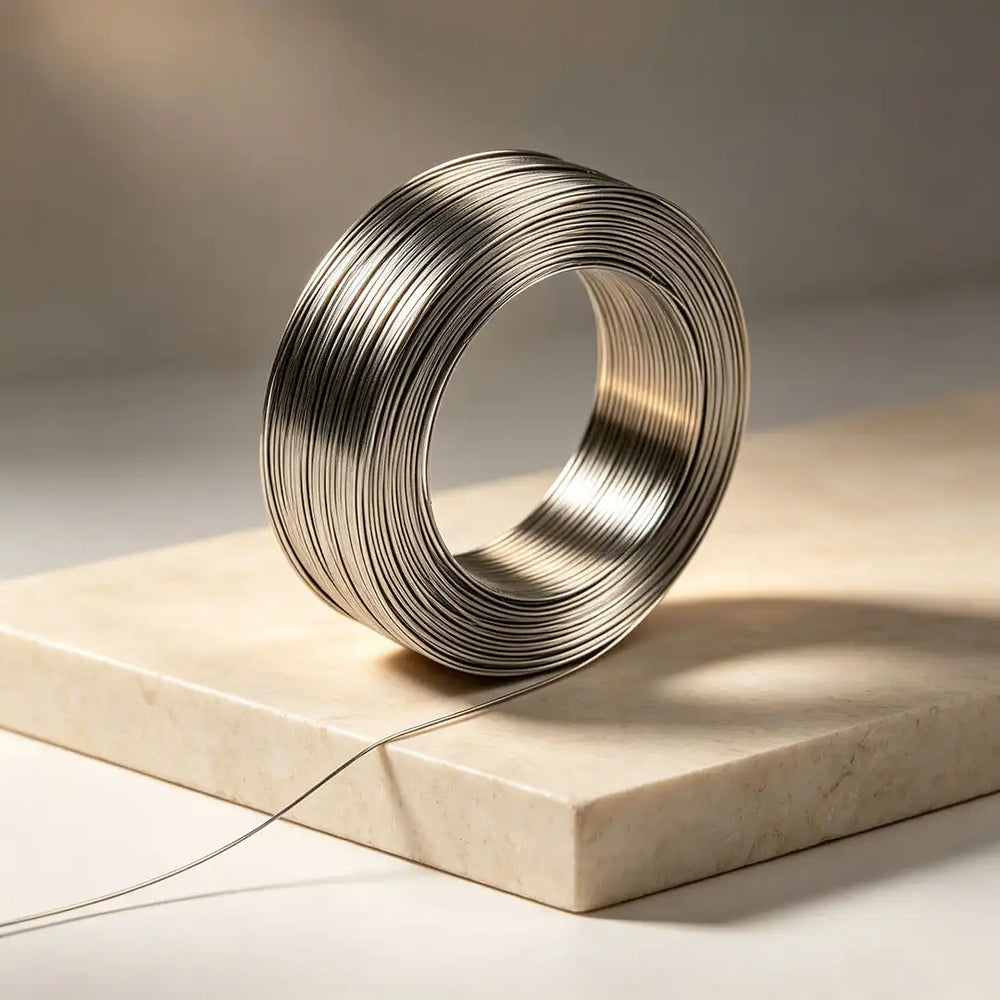
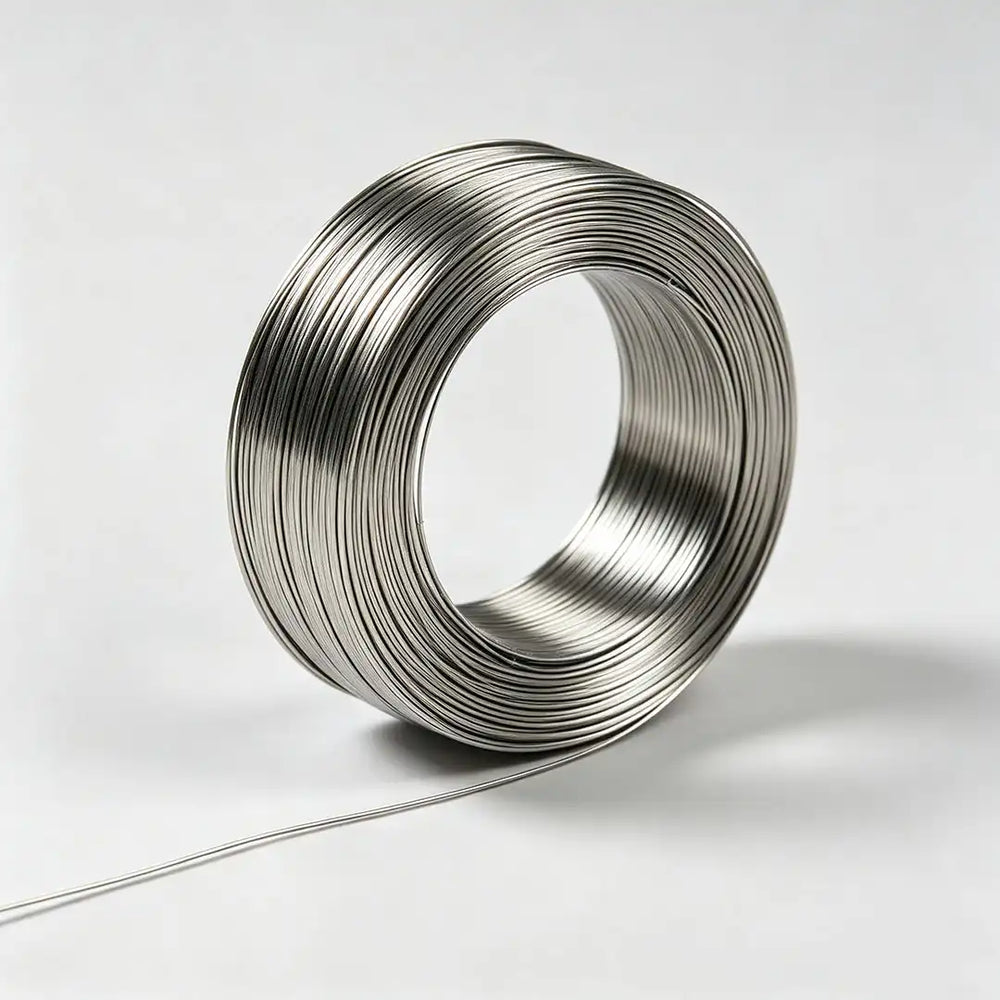

High-Purity Titanium Wire 99.99% (4N) Research Grade
On this page What 4N high-purity wire is Properties for research Diameters, forms & packaging How it...
- $18.00
- $18.00
- Unit price
- per
Please hurry! Only 10000 left in stock
Subtotal:
$18.00
Get a Custom & Bulk Quote
Couldn't load pickup availability
Shipping
We provide an end-to-end tracking number.
Dispatch time
Normally 1-3 days. For customized items, the time will be extended depending on manufacturing complexity.
Other sizes
Please contact us for other specifications. / If you need other specifications, please contact us.


Description
x4N High-Purity Titanium Wire, 99.99% for Research and Laboratories
4N high-purity titanium wire is elemental titanium wire drawn to a purity of 99.99% — "four nines," written 4N — on a trace metals basis, for scientific research, analytical work, thin-film deposition, electrochemistry, and laboratory fabrication. Unlike engineering titanium that is specified by an industrial grade and judged mainly on mechanical strength, research-grade 4N wire is specified by its chemistry: total metallic impurities are held to extremely low levels so that trace contaminants cannot interfere with sensitive experiments. It is supplied in fine diameters, small spools and reels, and short cut lengths, sealed clean for the bench.
Elemental titanium carries CAS number 7440-32-6 and chemical formula Ti. This page explains what 4N and "trace metals basis" mean, how purity levels compare, the diameters and packaging used in labs, how clean high-purity wire is produced, the research applications it supports, and how to select and handle it for reproducible results.
What "4N" and "Trace Metals Basis" Mean
The N notation counts the nines in the purity figure: 4N means four nines, i.e. 99.99% titanium, leaving at most 0.01% total trace metallic impurity. "Trace metals basis" is the standard research-chemistry convention used by laboratory material suppliers: the stated purity is calculated against metallic trace elements, so researchers can compare materials on a consistent basis across suppliers and publications.
Purity Levels at a Glance
| Designation | Purity | Typical research use |
|---|---|---|
| 2N6 | 99.6% | General lab tooling, non-critical apparatus, teaching labs |
| 3N | 99.9% | Routine electrochemistry, general deposition, pilot experiments |
| 4N (this product) | 99.99% | Thin-film and evaporation work, analytical research, most trace-sensitive studies |
| 5N | 99.999% | Ultra-trace analysis, frontier materials and surface-science work |
Why Researchers Choose 4N Over Industrial Titanium Wire
Industrial commercially pure titanium is defined by engineering grades that deliberately allow controlled oxygen, iron, and interstitial content to tune strength and formability; its purity typically sits well below the 4N threshold. That residual chemistry is irrelevant for a bracket or a fastener but can dominate an analytical result. 4N wire is refined specifically to minimize those elements, giving a clean, consistent starting material.
Why Low Trace Metals Matter for Sensitive Experiments
In spectroscopy, electrochemistry, and deposited films, even parts-per-million levels of iron, nickel, chromium, or alkali metals produce background peaks, unintended redox behavior, off-stoichiometry, or contaminated coatings. A 99.99% starting wire keeps that background predictable and small, so measured signals reflect the experiment rather than the source material.
Reproducibility Across Long-Running Studies
Recording Material Details in the Methods Section
Because 4N wire is defined by a fixed purity figure, CAS number, form, and diameter, a researcher can record those exact specifications in a paper's methods section, and a colleague months or years later can repeat the work against the same documented chemistry — a level of consistency that ordinary, unspecified industrial wire cannot provide.
Properties Relevant to Research
The reference values below support experimental design and describe typical behavior for 4N titanium wire.
| Property | Value / behavior |
|---|---|
| Purity (assay) | 99.99% (4N), trace metals basis |
| CAS number | 7440-32-6 |
| Formula / molar mass | Ti / 47.87 g/mol |
| Density | Approx. 4.5 g/cm³ |
| Melting point | Approx. 1,660–1,668 °C |
| Boiling point | Approx. 3,287 °C |
| Electrical resistivity | Approx. 42 µΩ·cm at 20 °C |
| Magnetic response | Non-magnetic |
| Surface behavior | Self-forming, stable passive oxide film |
| Available temper | As drawn or annealed |
Chemical Purity and Controlled Trace Impurities
4N wire is refined to keep both metallic trace elements and gaseous interstitial elements (oxygen, nitrogen, hydrogen) low, with tightly controlled impurity levels so the source material adds minimal background to an experiment.
Physical and Thermal Behavior
Titanium's high melting point, low density, non-magnetic character, and stable oxide make 4N wire useful as an evaporation source, an electrode, and a high-temperature structural lead. Its passive surface also tolerates a wide range of electrolytes, which is why pure titanium is a common electrode and current-collector material in electrochemical cells.
Surface Condition: As-Drawn vs. Annealed
As drawn
A firmer, work-hardened wire with a bright drawn surface; holds shape for leads, jigs, and controlled winding where stiffness helps placement.Annealed
A softer, more ductile wire after clean vacuum or protective-atmosphere annealing; easier to bend, wrap, and form into filaments, coils, and delicate electrodes.Diameters, Forms and Laboratory Packaging
Research work is defined by small, precise amounts rather than bulk tonnage, so 4N titanium wire is offered in fine diameters, compact forms, and short, orderable lengths.
Fine Diameters for Laboratory Work
Fine and ultra-fine cross-sections dominate laboratory demand, from evaporation filaments around a fraction of a millimeter to sturdy one-millimeter electrode stock. The same material can be drawn across a range of diameters for a multi-stage study.
Common Research Diameters and What They Suit
| Diameter range | Common laboratory use |
|---|---|
| 0.125–0.127 mm | Thermal evaporation filaments, micro-electrodes, fine winding and probes |
| 0.25 mm | Evaporation and heater wire, small electrodes, sol-gel / microextraction substrates |
| 0.5 mm | Electrochemical electrodes, contact leads, coil and spiral winding |
| 1.0 mm | Counter electrodes, structural leads, apparatus and fixture wire |
Diameters finer or heavier than the standard research range can be drawn to order; select the cross-section that matches the technique and the available fixture.
Reels, Spools and Straight Lengths
- Reels / small spools — continuous, tangle-free wire for evaporation winding, coilers, and repeated small experiments.
- Straight cut lengths — pre-cut segments for electrodes, probes, and apparatus that must be ready to mount with no further handling.
- Longer continuous length — larger spools for groups and core facilities that consume wire regularly.
Small Quantities and Cut-to-Length Service
Laboratory orders are accepted in small quantities — by the centimeter, inch, meter, or by the gram, including short 100 mm segments and 1 m / 5 m / 10 m reels — so a single experiment or thesis project can be supplied without industrial minimums. Lengths and spool sizes can be cut and wound to match a specific rig.
Sealed, Clean Packaging
Each reel or length is degreased, handled to avoid metal-to-metal contamination, and sealed in clean, labeled protective packaging that preserves the bright high-purity surface until it reaches the bench. Labels carry the diameter, form, and purity for quick identification.
How 4N Titanium Wire Is Produced
Reaching and preserving four-nines purity demands a cleaner route than ordinary wire drawing, because contamination introduced at any stage cannot be "drawn out" later.
High-Purity Melt and Impurity Control
Production starts from high-purity feedstock refined under vacuum melting, often with multiple remelts that drive down volatile and metallic impurities and tightly control oxygen and nitrogen. The aim is a clean, homogeneous base before any forming begins — the step that separates 4N research material from engineering titanium.
Multi-Pass Drawing to Fine Diameters
The purified stock is reduced through a sequence of drawing dies toward laboratory diameters, using dedicated, contamination-controlled tooling so that iron or other tooling metals are not embedded in a nominally pure surface. Intermediate vacuum annealing keeps the wire workable as it is drawn finer.
Maintaining Purity Throughout Drawing
Because a single contaminated die or shared line can adulterate an ultra-pure wire, fine research wire is drawn under segregated, clean conditions and handled to keep the surface free of steel contact, lubricant residue, and shop-floor dust.
Cleaning, Annealing and Clean Packaging
Final processing combines thorough degreasing, clean vacuum or protective-atmosphere annealing to set the as-drawn or annealed temper, and a last clean before sealed packaging. In-process impurity checks confirm the material stays within the 4N limit before it is wound, cut, and sealed for delivery.
Research Applications of 4N Titanium Wire
Thin-film & evaporation
High-purity wire is wound into thermal evaporation filaments and source holders for PVD and thin-film deposition; 4N purity keeps evaporated films free of source-derived contaminants.Electrochemistry
Used as working, counter, and auxiliary electrodes, current collectors, and contact leads in cells where a clean, corrosion-resistant, non-magnetic conductor is required.Corrosion & materials science
A clean pure-titanium reference for passivation, oxide-film, anodizing, and corrosion studies where known starting chemistry is essential.Analytical & reference work
A low-background material for spectroscopy and trace analysis, method development, and comparative research.Thin-Film Deposition and Thermal Evaporation
Why Source Purity Sets Film Quality
In thermal evaporation and PVD, every impurity in the source wire is available to transfer into the growing film, altering composition, resistivity, optical behavior, or adhesion. A 99.99% source minimizes that carry-over, yielding cleaner, more repeatable coatings — the main reason deposition labs specify 4N rather than engineering-grade wire.
Electrochemistry and Electrodes
4N titanium wire serves as counter and auxiliary electrodes, structural electrode supports, and current collectors in battery, corrosion, and sensor research. Its passive oxide and electrolyte tolerance give stable behavior, while the low trace-metal content removes an uncontrolled variable from the cell.
Spectroscopy, Standards and Reference Work
Known-purity titanium provides a clean baseline for analytical methods, comparative studies, and calibration-style work where the sample's own impurities must not be confused with the signal under investigation.
Specialized and Emerging Research
The wire also appears as a substrate for sol-gel and microextraction fibers, in biomedical and implant-material R&D, low-temperature and non-magnetic setups, anodizing-color studies, and custom experimental apparatus where a light, inert, heat-resistant conductor is needed.
Prototyping and Laboratory Tooling
Beyond bench science, small lengths support research prototypes, leads, supports, jigs, and fixtures in clean or corrosive environments, with cut-to-length delivery that matches a one-off build rather than a production run.
How to Choose 4N Titanium Wire
Step 1 — Confirm the Purity Level
Choose 4N when trace metallic background would affect films, electrochemistry, or analysis; routine teaching or mechanical lab tooling may be served by 3N, while ultra-trace and surface-science work can require 5N.
When to Move Up to 5N
If an experiment resolves impurities at sub-parts-per-million level, or if results are intended for publication against the lowest achievable background, stepping from 4N to 5N removes the source material as a limiting factor.
Step 2 — Match Diameter to the Technique
Use the finest cross-sections for evaporation filaments and micro-electrodes, mid sizes for general electrodes and winding, and heavier wire for counter electrodes and structural leads.
Step 3 — Choose Form, Temper and Length
Pick reels or spools for continuous winding and repeated runs, straight lengths for ready-to-mount electrodes, as-drawn wire for stiffness, and annealed wire for tight forming — then set the length or spool size to the rig.
Step 4 — Match Quantity and Packaging to the Project
Choose short cut lengths or a small reel for a single experiment, and larger spools for ongoing group use; select sealed clean packaging when the wire will be stored between runs or used in clean and deposition environments.
Handling 4N Wire in the Laboratory
- Wear clean gloves and use titanium, ceramic, or dedicated cutters; avoid steel tools that can embed iron into a high-purity surface.
- Degrease with a suitable solvent such as acetone or ethanol and allow to dry under clean conditions before evaporation or electrode use.
- Keep unused wire in its sealed packaging, away from grinding dust and other metal stock.
- Separate open lengths by purity and diameter so the correct wire is used for each experiment.
- Avoid dragging fine wire across sharp edges, where nicks could cause breaks during winding or evaporation.
Frequently Asked Questions
What does 4N / 99.99% mean?
4N means "four nines," a purity of 99.99% titanium, with total trace metallic impurity no greater than 0.01%. It sits one step above 3N (99.9%) and one below 5N (99.999%) in research purity levels.
What does "trace metals basis" mean?
It is the standard research-chemistry way of stating purity: the purity is expressed against metallic trace elements, so researchers can compare laboratory materials from different suppliers on one consistent basis.
Is 4N research wire different from industrial pure titanium wire?
Yes. Industrial titanium is specified by engineering grades that allow controlled oxygen and iron for mechanical behavior, while 4N wire is specified by chemistry and refined to far lower trace impurities for reproducible, trace-sensitive research.
Which diameter suits evaporation or electrode work?
Fine 0.125–0.25 mm wire is typical for thermal evaporation filaments and micro-electrodes; 0.5 mm suits general electrodes and winding; around 1.0 mm is used for counter electrodes and structural leads.
How is the wire kept clean before it reaches the bench?
It is degreased after drawing, handled to avoid steel contact and dust, and sealed in clean labeled packaging that protects the bright high-purity surface; a final solvent wipe before use is still recommended for deposition and electrode work.
Can I order a very small quantity or a short cut length?
Yes. Research quantities are supplied by the centimeter, inch, meter, or gram — including short segments and small 1 m / 5 m reels — with cut-to-length and custom spool sizes for specific apparatus, without industrial minimums.
What is the CAS number for titanium wire?
Elemental titanium, including high-purity wire, carries CAS number 7440-32-6 and chemical formula Ti.
As-drawn or annealed — which should I choose?
Choose as-drawn for a stiffer wire that holds position in leads and jigs; choose annealed for a softer, more ductile wire that bends and wraps easily into filaments, coils, and delicate electrodes.
Is higher-than-4N purity available?
Yes — 5N (99.999%) wire can be supplied for ultra-trace and surface-science research where even the 4N background must be minimized; select it when results are published against the lowest achievable impurity level.
Summary
4N high-purity titanium wire provides 99.99% elemental titanium on a trace metals basis (CAS 7440-32-6), refined and drawn under contamination-controlled conditions for research rather than for engineering load. Offered in fine diameters, small reels and spools, and short cut lengths, in as-drawn or annealed condition, and sealed in clean protective packaging, it gives thin-film and evaporation work, electrochemistry, corrosion and analytical studies, and specialized laboratory apparatus a clean, reproducible, well-characterized starting material. Defining purity, diameter, form, temper, length, and packaging up front ensures the wire that reaches the bench matches the experiment it supports.
Shipping & Return
xReturns Policy
You may return items within 30 days of delivery for a full refund. We'll also pay the return shipping costs if the return is a result of our error (you received an incorrect or defective item, etc.).
You should expect to receive your refund within four weeks of giving your package to the return shipper, however, in many cases you will receive a refund more quickly. This time period includes the transit time for us to receive your return from the shipper (5 to 10 business days), the time it takes us to process your return once we receive it (3 to 5 business days), and the time it takes your bank to process our refund request (5 to 10 business days).
If you need to return an item, simply login to your account, view the order using the "Complete Orders" link under the My Account menu and click the Return Item(s) button. We'll notify you via e-mail of your refund once we've received and processed the returned item.
Shipping
We can ship to virtually any address in the world. Note that there are restrictions on some products, and some products cannot be shipped to international destinations.
When you place an order, we will estimate shipping and delivery dates for you based on the availability of your items and the shipping options you choose. Depending on the shipping provider you choose, shipping date estimates may appear on the shipping quotes page.
Please also note that the shipping rates for many items we sell are weight-based. The weight of any such item can be found on its detail page. To reflect the policies of the shipping companies we use, all weights will be rounded up to the next full pound.
Related Products
Example product title
- $18.00
- $18.00
- Unit price
- per
Example product title
- $18.00
- $18.00
- Unit price
- per
Example product title
- $18.00
- $18.00
- Unit price
- per
Example product title
- $18.00
- $18.00
- Unit price
- per
Example product title
- $18.00
- $18.00
- Unit price
- per
Example product title
- $18.00
- $18.00
- Unit price
- per
Example product title
- $18.00
- $18.00
- Unit price
- per
Example product title
- $18.00
- $18.00
- Unit price
- per
Example product title
- $18.00
- $18.00
- Unit price
- per
Example product title
- $18.00
- $18.00
- Unit price
- per
- Choosing a selection results in a full page refresh.